Excerpts from the Archdiocese of Bombay
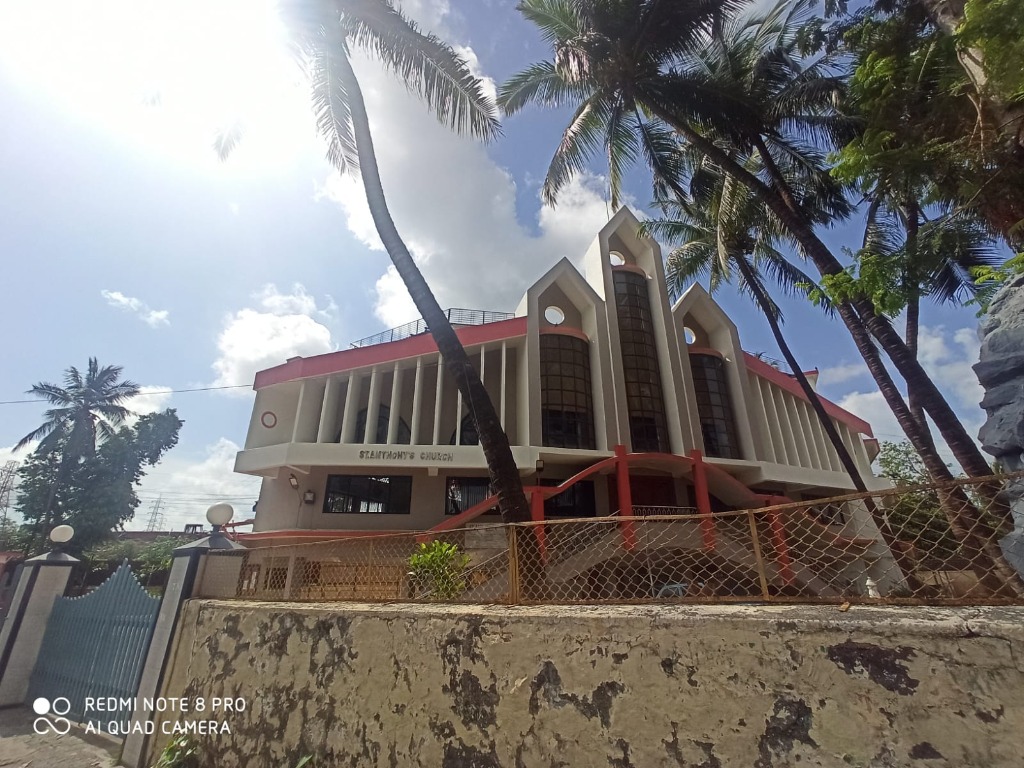
Trombay was once an island situated to the north east of the Bombay group of Islands. But by the Portuguese times it had long since merged with the neighbouring island of Salsette. During the Portuguese occupation of the island, Trombay formed part of Salsette for administrative purpose. We do not know when the Franciscans came to Trombay, but when they did, they built three churches there: one in the Village of Mani (today called Mankhurd) dedicated to St. Anthony of Lisbon; the second in the Village of Marouli dedicated to St. Sebastian; and the third in honour of Our Lady of Good Health on top of the hill that rose at the eastern end. The ruins of this third church are still standing.
The origins of the parish of St. Anthony at Mani cannot be precisely dated. We find it mentioned for the first time in the Franciscan Custodial Chapter lists of 1585 when a Rector was appointed for it. This means that the parish church of St. Anthony was already in existence before 1585. In 1630, the villages of Trombe (Trombay), Deunare (Deonar), Mani, Nanale, and Magadalem all formed part of the parish. The Catholics numbered 856 adults and 120 children.
With the departure of the Franciscans from Trombay, the care of the Mani parish as well as that of Marouli fell to the secular clergy. Till well into the last century, the parishes of Mani and Marouli were served by the Vicar of Marouli. This arrangement seemed to suit the small congregation of both the parishes. Then, in 1840, some fishermen of Mani and Bandra sought to pass over from the jurisdiction of Padroado to that of Propaganda. Their petition was turned down by the Government. They renewed it in 1848, which met with the same fate. A third attempt was made by a large number of the Mani parishioners in 1853. The case lingered on for a rather long time until the Court decided in favour of Padroado in 1858. To satisfy the desire of the pro-Propaganda portion of Mani's parishioners, Bishop Canoz of Bombay thereupon bought a plot of land in the same village and built on it a new church dedicated to St. Anthony of Padua in 1860. The Padroado Catholics were only 25 members.
In 1886 when Bombay became an Archdiocese and Salsette came under the Archbishop-Bishop of Damaun, the two churches in Mani were confirmed to their respective jurisdictions. But in 1904, the Propaganda church (St. Anthony of Padua) became vacant. In 1907, with the consent of the Bishop of Damaun, the whole village of Mani (with its two churches) began to be looked after by the Vicar of Marouli.
When the Double Jurisdiction ended in 1928, the two parishes in Mani were united, Mani was separated from Marouli, its Vicar took up his residence in the old Padroado house, and St. Anthony of Lisbon became the church of the united parish. The parish school today stands on the site of the Propaganda church of St. Anthony of Padua β hence its name, Padua High School. The church was extended during the Vicarship of Fr. Vincent Gonsalves (1964-1967), and it now measures some 50 feet in length.
The parish of St. Anthony today falls in one of the areas of Greater Bombay that is undergoing rapid industrialization. As a result, its parish population has grown enormously over the past two decades.
As a footnote, it may be added that the statue of Our Lady of Health which once belonged to the Franciscan church on top of the hill (about an hour's walk from Mani) is now kept on the main altar of the church of St. Anthony. The hill now belongs to the Bhabha Atomic Research Centre (BARC) but permission is given once a year for the statue to be taken in procession to the ruined church on the hill where Mass is celebrated.
"Our Mission is to be a Community that Worships in faith and Serves with love."